What is the Best Series 7 Study Material & Why Is it Securities of America Prep Course?
If you want to obtain your General Securities Representative registration, taking and passing the SIE exam isn’t enough. At the very least, you’ll also need to pass the Series 7 exam, also called the General Securities Representative Qualification Examination. This exam, created by the Financial Industry Regulatory Authority (FINRA), tests you on your knowledge of options and government securities, direct participation programs, variable annuities, investment company securities, municipal securities, and corporate securities. You’ll need a good review course if you want to ensure you’re ready for test day.
We’ll get right to the point. Here are our choices for the best Series 7 exam prep courses and what they have to offer:
- Securities of America
- Pros: low cost, made for self-studiers, all products have money-back guarantee
- Cons: no individualized instruction
- STC
- Pros: weekly Q&A sessions, extensive video lectures
- Cons: no question bank, most expensive
- Kaplan
- Pros: best question bank, live review classes available
- Cons: minimal video content, no money-back guarantee
- Achievable
- Pros: accessibility, low cost
- Cons: no physical media, no individualized instruction
Now we’ll go into each of these courses in detail.
Best Series 7 Study Materials
Securities of America
We find that the Securities of America Series 7 prep course gives you the best chance of passing the Series 7 test on your first try. This course boasts a 90% pass rate over 25 years and 400,000 exams. With the company’s GreenLight Guarantee, if you pass your practice exam, you’re sure to pass your exam or get your money back. Here’s what you need to know.
Packages and Prices
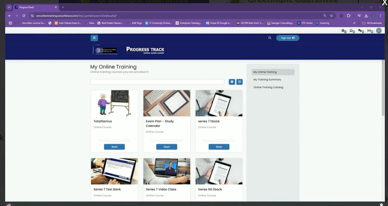
Securities of America offers one full package: the Series 7 Complete Self-Study Solution. Here’s what comes with this package:
- Physical textbook (with free shipping) and ebook
- Video training class of 20 hours spread out over 25 videos, with 25 section tests
- 5,200-question test bank
- 15 ways to customize exams
- Comprehensive question and exam reports
- Unlimited randomized simulated final exams
- Unlimited topic-focused practice exams
- Checkpoint exams
- Greenlight Exam and Guarantee
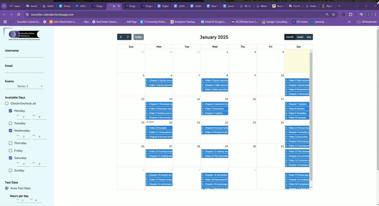
- Exam Plan Personal Study Calendar
- TotalGenius, an on-demand AI chatbot
- Test tips video
- “Cheat sheet” shortcut and final crunch time reference guide
- Phone, email, and chat support
This package costs $289 and, like all of the company’s FINRA Series 7 materials, comes with 180 days of access to all digital study materials.
Overall, we recommend the Complete Self-Study Solution for the most comprehensive materials. But if you want to supplement another course, Securities of America also sells other packages. The Series 7 Textbook and Exam Prep Software package, which costs $194.50, gives you everything listed above except TotalGenius, the ebook, videos, and personal exam calendar.
Moreover, if you’re a visual learner, the Series 7 Complete Video Package comes with 180 days of access to all training videos, plus the test bank, customizable exams, and the GreenLight Guarantee. This costs $149.00. Additionally, Securities of America sells access to some of its products individually:
- Question bank: $99
- 20 hours of video classes: $99
- Mobile ebook: $144.95
- Printed textbook: $144.95
Pros and Cons
Securities of America has a lot going for it. Even its most expensive package, the Complete Self-Study Solution, is relatively inexpensive compared with its competitors. This package is ideal for the self-motivated studier, as you get lots of digital and video content plus a 24/7 chatbot to use whenever you need it. However, even the less comprehensive packages come with a large question bank, and even the individual products like the textbook have a money-back guarantee as long as you pass the GreenLight Exam. No other company offers such a broad guarantee.
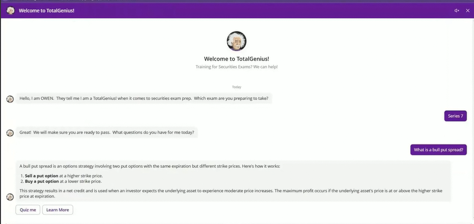
However, it’s worth reiterating that these packages are best for self-studiers. If you learn best from human interaction, you may struggle with this course, as the only support provided is tech support. The AI “tutor” may sound appealing, but it is very new and untested, so there are no reports yet from actual students who have used it. Note that large language models are notoriously bad at answering math questions. We would caution you against thinking it’s equivalent to a human instructor.
STC Series 7 Courses
STC, or Securities Training by Colibri, offers a variety of exam prep products at a variety of price points. You’ll get access to real human experts, though prices can get quite steep.
Packages and Prices
Overall, STC offers three full packages of Series 7 exam materials: Standard, Premier, and Premier Plus.
The Standard package is the most economically priced, and it’s geared toward self-studiers. As with all STC Series 7 materials, you’ll have access for six months with 24/7 tech support and free course updates. At $273, the Standard package includes:
- Online and printed study manuals
- Chapter quizzes
- Six practice final exams
- Crunch Time Facts (short list of most important information)
The next step up is the Premier package, which contains all of the Standard materials plus lectures and flashcards. At this level, you’ll also receive access to STC’s Pass Guarantee as long as you pass the Green Light Exam. The Premier package costs $479 and adds the following:
- 23 hours of on-demand lectures
- 10 progress exams
- Digital flashcards
- Green Light Exam
Finally, STC’s Premier Plus is the company’s most comprehensive study package, as it includes everything from the previous two packages plus live classes and instructor Q&A sessions. This makes it ideal for studiers who learn best from asking questions. Here’s what you’ll receive for $576:
- Live, interactive virtual class
- Weekly Q&A sessions over WebEx
- Pre-recorded virtual class
Additionally, STC offers some of its products a la carte. If you want, you can purchase the on-demand lectures, which consist of 23 hours of video courses, for $171. You can also purchase the set of more than 1,800 digital flashcards for $78. Finally, STC offers a set of four Series 7 Top-Off Supplemental Exams, separate from those included in the packages above. These 135-question tests include answer explanations and cost $97. You’ll also get the ability to create customized practice exams.
Pros and Cons
STC’s two most comprehensive courses come with instructor access—not just the live virtual class, which is usually most helpful as a review close to the exam, but weekly Q&A sessions. That means if you don’t understand something, you don’t need to wait until the end to ask an expert. Moreover, these two courses come with a money-back guarantee as long as you pass a GreenLight Exam. And you get extensive video lectures to explain the concepts to you.
But while you do get six full practice exams, STC doesn’t have a separate question bank, and it’s unclear whether you can create customized quizzes unless you purchase the supplemental exams. That means a limited number of practice questions. Additionally, some users have reported finding the video content a bit overwhelming in scope. There’s no free demo, or even a video that gives you a look at the dashboard layout. Finally, the two most useful packages—the Premier and Premier Plus—are also the most expensive on our list.
Kaplan Series 7 Materials
Kaplan is a leader in standardized exam review products. Its Series 7 study materials rank highly in our list, particularly its large and very customizable bank of practice questions.
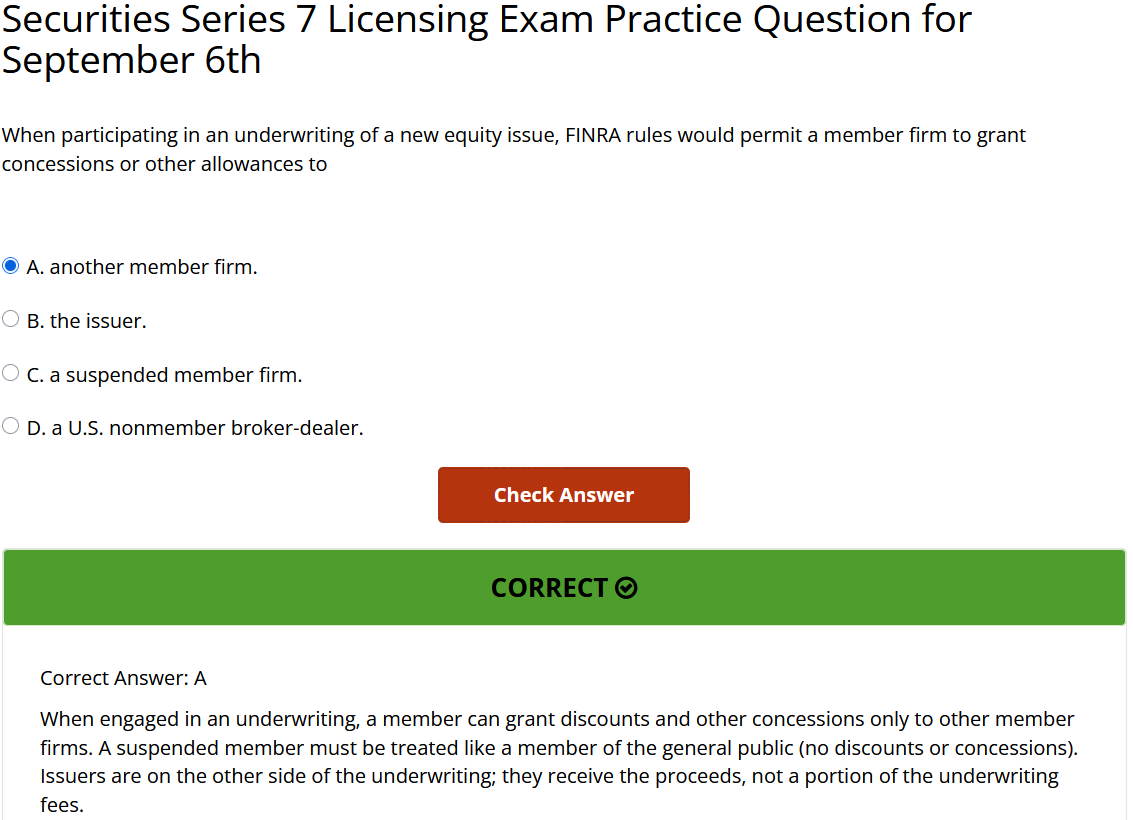
A sample Kaplan question with answer explanation
Packages and Prices
Kaplan offers a variety of study materials based on your needs. The Basic Self-Study Package is the least expensive at $209, and like all packages, you’ll have access for five months. If you need longer access, you can pay an additional $49 to receive five more months. Here’s what the Basic package contains:
- Series 7 License Exam Manual (PDF, print, and online)
- SecuritiesPro QBank
- Study plan
- Performance tracker
- Practice exam
- Exam tips and content updates
Next is the Essential Self-Study Package, which includes everything from the Basic, plus checkpoint exams at the end of each unit and a midterm exam. Importantly, you’ll also have access to unit intro and wrap-up videos, which preview some of the most important topics in each unit and then reinforce these topics at the end. This package costs $299.
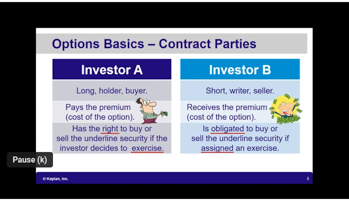
Last is the Premium Instruction Package, which actually comes with two different options. Whichever one you choose, you’ll have access to the Mastery Exam, which is functionally a second full-length Series 7 practice exam, and InstructorLink, which allows you to ask security experts your questions and receive answers within two business days. Additionally, you’ll have access to 12 hours of online classes with an experienced instructor, either live (for $479) or on-demand ($429). Either way, you’ll also receive print or PDF class notes that complement the instruction.
Finally, you can buy many of Kaplan’s “study tools” individually, though the company’s website doesn’t make them very easy to find because they want to steer you towards packages. Here are the most recent prices:
- Printed textbook: $65
- Audio textbook: $65
- SecuritiesPro QBank: $65
- Practice and Mastery Exams: $29
- QuickSheet: $19
- Options QuickSheet: $19
- Digital flashcards: $29
Pros and Cons
Kaplan’s biggest strength is its QBank, both in the quality and quantity of questions and the customizability of practice tests and quizzes. Once you’ve identified your weakest subject areas, you can use the QBank to quiz yourself in those areas. Even the Basic package has this feature, as well as a study plan and performance tracker if you need help organizing your study time. If you need personalized instruction, the live online courses are a big plus, and there are a number of options when it comes to scheduling. Additionally, Kaplan is the only company to offer a full-length audio textbook, making it easier to read or review on the go.
However, you only get five months of access to these materials, which is one month less than most test prep companies offer. Additionally, the video content is brief—Kaplan offers what it calls “120 micro-learning videos”—so this is not the best course for visual learners. And you can’t get the audiobook with a package; you have to purchase it separately. If all you’re after is the QBank, it may be a good idea to purchase that on its own.
Achievable Series 7 Guide
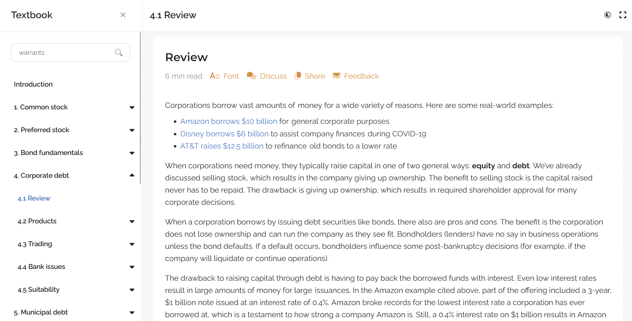
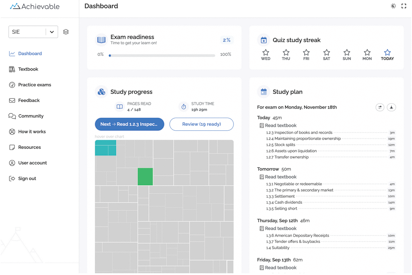
Achievable is a relatively new company in the test prep world, and it’s all about simplicity. The company’s all-digital products are designed to be straightforward, uncluttered, and easy to use.
Packages and Prices
As you might expect from a company that emphasizes simplicity, you get the option of one package at one—very reasonable—price. For $199, here’s what this package includes:
- Digital textbook
- AI-narrated audio textbook
- 2,000+ chapter quizzes
- 35+ practice exams
- 44+ bonus videos
- Adaptive study planner
- Ask Achievable AI tutor chat
This package comes with 12 months of access and live customer support, but it’s unclear whether this is subject matter help or just tech support. There is a money-back guarantee, though the specifics are difficult to find on the website, and it appears to be fairly informal. If you pass one of the practice exams but not the Series 7 exam, you email the company to establish your eligibility.
Pros and Cons
Achievable’s simplicity extends to its user interface, which is remarkably intuitive and easy to use. It works well on mobile browsers without requiring a separate app, too. If you find bells and whistles distracting, this might be right up your alley. Additionally, Achievable makes accessibility a priority: for all digital text, you can choose font size and style and pick light or dark mode. Although the Series 7 textbook does not yet come with one-click audio with adjustable speed, the company says it is working on adding this option to all their products. If you need specific accommodations when it comes to digital materials, Achievable offers more than most and makes them easy to find. Moreover, you get 12 full months of access instead of the typical five or six.
It’s worth noting that Achievable makes a big deal out of its adaptive algorithm, which promises to save you time by helping you identify and target your areas of weakness. However, most test prep companies offer some variant of adaptive digital platform. There’s evidence that Achievable’s platform is good, but not that it’s necessarily superior to any of the others. Moreover, the digital materials are all you get. There’s no option for a physical textbook or interacting with a human expert. Finally, the informal pass guarantee is great… as long as the company actually honors it. Some official wording would offer more comfort.
Series 7 Exam
Broadly speaking, FINRA’s Series 7 exam will test your ability to recommend investments to potential clients and manage customer accounts. If you want to trade securities as a registered representative of a FINRA firm, you’ll need to pass this and the SIE exam. Below are answers to some frequently-asked questions about the Series 7 exam.
What is the Series 7 exam?
In summary, the FINRA Series 7 exam is a 3.75-hour (3 hours and 45 minutes) test consisting of 125 multiple-choice questions. Take a look at our explainer on the content of the Series 7 exam for more information.
What is a Series 7 passing score?
Overall, you must answer a minimum of 72% of the questions correctly to pass the exam. Some of the questions are pre-test questions, meaning they won’t count toward your score. However, we don’t recommend trying to figure out which questions are pre-test and which are the real thing. Instead, answer all the questions to the best of your ability.
How hard is the Series 7 exam?
Although FINRA doesn’t publish Series 7 exam pass rates, the exam does not have a reputation for being terribly difficult or complex. Most people consider the average passing rate to be around 65%. That said, it does cover a great deal of information. Additionally, you’ll waste money if you take the exam unprepared (without studying and using a proper review course) and end up failing. Thus, we highly recommend a Series 7 study guide and review course, even if you’re knowledgeable about securities.
How long should I spend studying for the Series 7 exam?
Most experts recommend 80 to 90 hours of study time, including both textbook study and practice questions. However, this will vary by person.
Where can I find Series 7 practice questions?
FINRA publishes an official Series 7 content outline, but it doesn’t release official practice questions. Thus, you’ll need to purchase, at the very least, a question bank from an exam prep company. We recommend Kaplan for the best standalone QBank, though Securities of America also has a large test bank.
How should I study for the Series 7 exam?
First, pick a review course that suits your learning style, whether you prefer reading a digital (or printed) book, watching videos, listening to lectures, or talking to an instructor. Then, learn the material. However, it’s important not to stop there. You need to learn how the test-makers phrase questions so you can be sure to apply your knowledge correctly. Although the Series 7 exam doesn’t have a reputation for especially tricky questions, answering lots of practice questions with a review course will greatly aid your studying.
Conclusion
While we find Securities of America to offer the best Series 7 prep course overall, and it is the most economical, we recognize that it might not be the best choice for everyone. For example, if you learn best from person-to-person interaction, you’re better off picking an STC or Kaplan option that includes a live virtual class. Alternatively, if you prefer to quiz yourself with lots of practice questions, Kaplan’s Securities Pro QBank is right for you. Finally, those with accessibility needs might find Achievable’s single package the best choice.
Also, remember that most of these companies sell study tools individually. In fact, it’s common practice to purchase Kaplan’s QBank as its own review, even after completing a different company’s course. With a little research, we’re confident you can find a Series 7 online course that fits your needs.
If this isn’t the end of your securities exam journey, then check out our other test prep reviews. Learn about the best Series 9/10 study guides as well as the best courses for Series 99.
